

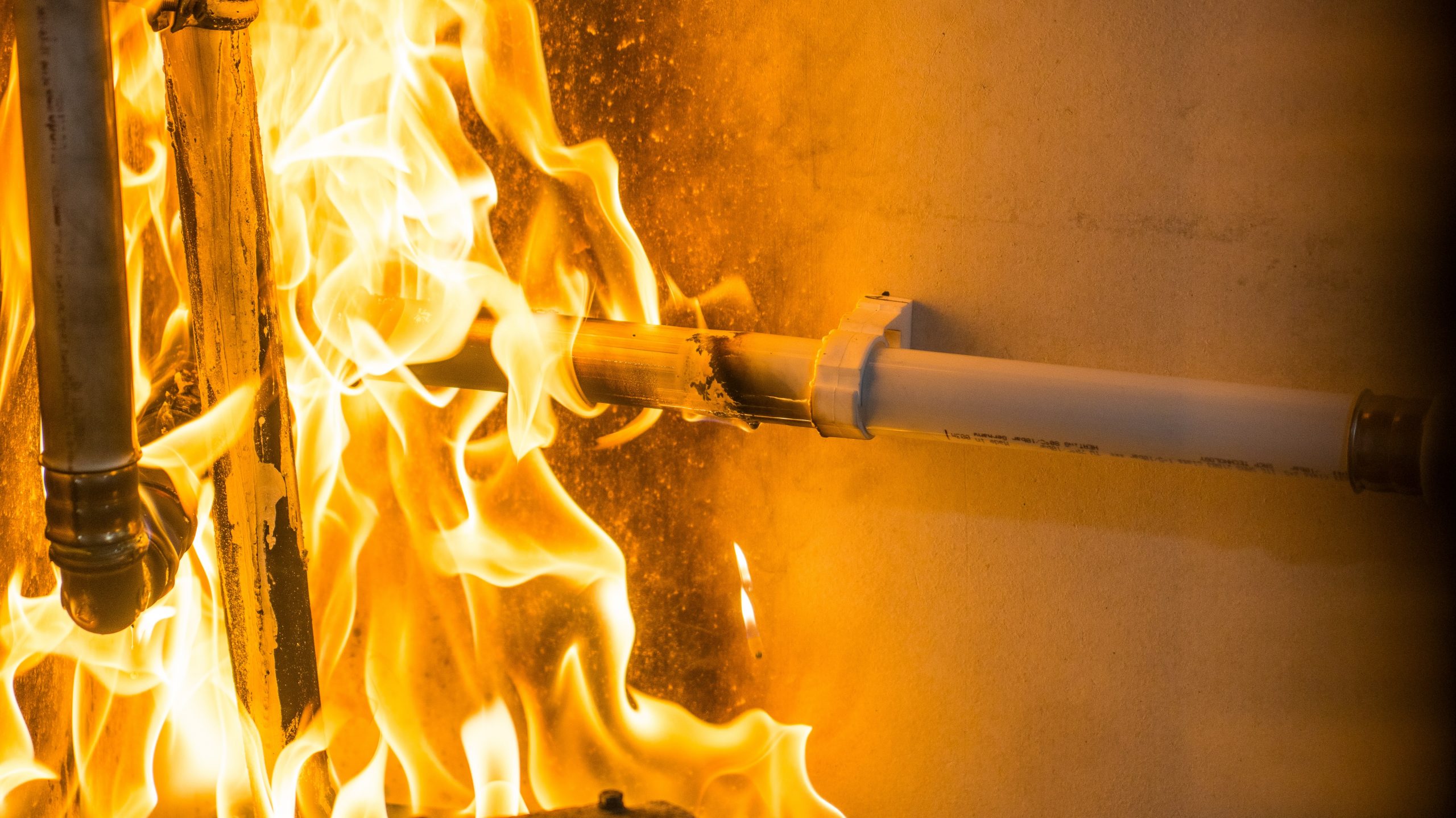
Plastic pipes are typically used in plumbing because they are seen as cost-effective and easily accessible, but industry experts have revealed how unknowingly dangerous they can turn out to be.
The Copper Sustainability Partnership (CuSP) has partnered with Warringtonfire to undertake independent research on what happens to plastic pipes when exposed to flames to see if these cost-effective solutions are safe.
Results showed that they not only burn quickly in a fire, but also release multiple toxic gases that go unseen and undetected by household smoke detectors.
Tests undertaken by Warringtonfire simulated real-life fire scenarios to measure how quickly different plumbing pipe materials react when exposed to flames.
This included tests on Multi-Layer Composite Pipe (MLCP), a common type of plastic pipe used in plumbing that is constructed in layers, with a layer of aluminium pressed between two layers of polyethylene (PEX) pipe.
MLCP not only burned in just over five minutes, but when burned these pipes release multiple toxic gases and fumes that will silently and unknowingly spread through a building and affect its occupants.
Research showed that MLCP pipes produce a high amount of carbon monoxide and hydrogen cyanide when burned. This deadly mix of gases can cause unconsciousness, seizures, respiratory failure, and even death if exposed for a significant amount of time. These gases are also highly flammable but go undetected by standard smoke detectors, meaning that by the time an alarm goes off, the fire and the gases it produces have already spread quickly, causing more damage to both a person and their home.
Andrew Surtees, Co-Founder of The Copper Sustainability Partnership, said: “We are beginning to see more instances of smoke alarms not being able to detect fires because they are happening more suddenly due to undetectable flammable gases igniting. The news commonly reports these fires when caused by lithium-ion batteries being used in new technologies, but not many people realise the risk of commonly used materials within their walls.
“Plastic pipes like MLCP are dangerous. Many underestimate the risks of these pipes because they believe that the water they store will extinguish a fire, but the gases these pipes produce can cause a fire to spread quickly, outpacing what small water reserves a pipe holds.”
Compared to other materials tested, like copper, MLCP produced 248 times more carbon monoxide in the five-minute period it burned, whereas copper was able to withstand heat of over 1000ºC without setting alight or releasing toxic fumes.
The independent study showed that the safest material to use in plumbing is copper, an infinitely recyclable, fire-resistant, long-lasting solution to tackle the dangers of plastic.
More information can be found at www.cuspuk.com